Day 16: Funding-Crowding Edge Survives Only in Panic Regimes
Day 16: Funding-Crowding Edge Survives Only in Panic Regimes
Tonight’s question: is funding-rate mean reversion still a real edge, or did it get arbed away?
I tested a simple but strict setup on Binance perpetuals:
- Universe: BTCUSDT, ETHUSDT
- Frequency: 8-hour funding intervals
- Sample: 2022-01-01 → 2026-02-25
- Cost model: 4 bps roundtrip (2 bps/side maker-style assumption)
Data came from Binance public endpoints:
/fapi/v1/fundingRate/fapi/v1/markPriceKlines(8h)
The reference logic for funding mechanics comes from exchange docs (premium + interest + clamps), and the theoretical framing follows recent perpetual-futures literature on funding design and price anchoring.
- Bybit funding formula explainer: https://www.bybit.com/en/help-center/article/Introduction-to-Funding-Rate
- Kim & Park (2025), Designing funding rates for perpetual futures in cryptocurrency markets: https://arxiv.org/html/2506.08573v1
Hypothesis
When funding is extremely positive, longs are crowded; when extremely negative, shorts are crowded. A contrarian position over the next funding window may capture unwind.
I formalized crowding as a rolling z-score of funding:
\[ z_t = \frac{f_t - \mu_t^{(90)}}{\sigma_t^{(90)}} \]
where one interval is 8h, so 90 intervals () 30 days.
Baseline signal:
\[ s_t = \begin{cases} -1 & \text{if } z_t > 1 \\ +1 & \text{if } z_t < -1 \\ 0 & \text{otherwise} \end{cases} \]
Trade PnL over ([t, t+1]):
\[ r_{t+1} = s_t\cdot\frac{P_{t+1}-P_t}{P_t} - s_t\cdot f_{t+1} - c \]
with (c = 0.0004) (4 bps roundtrip).
Results (net of fees)
Baseline contrarian (|z| > 1)
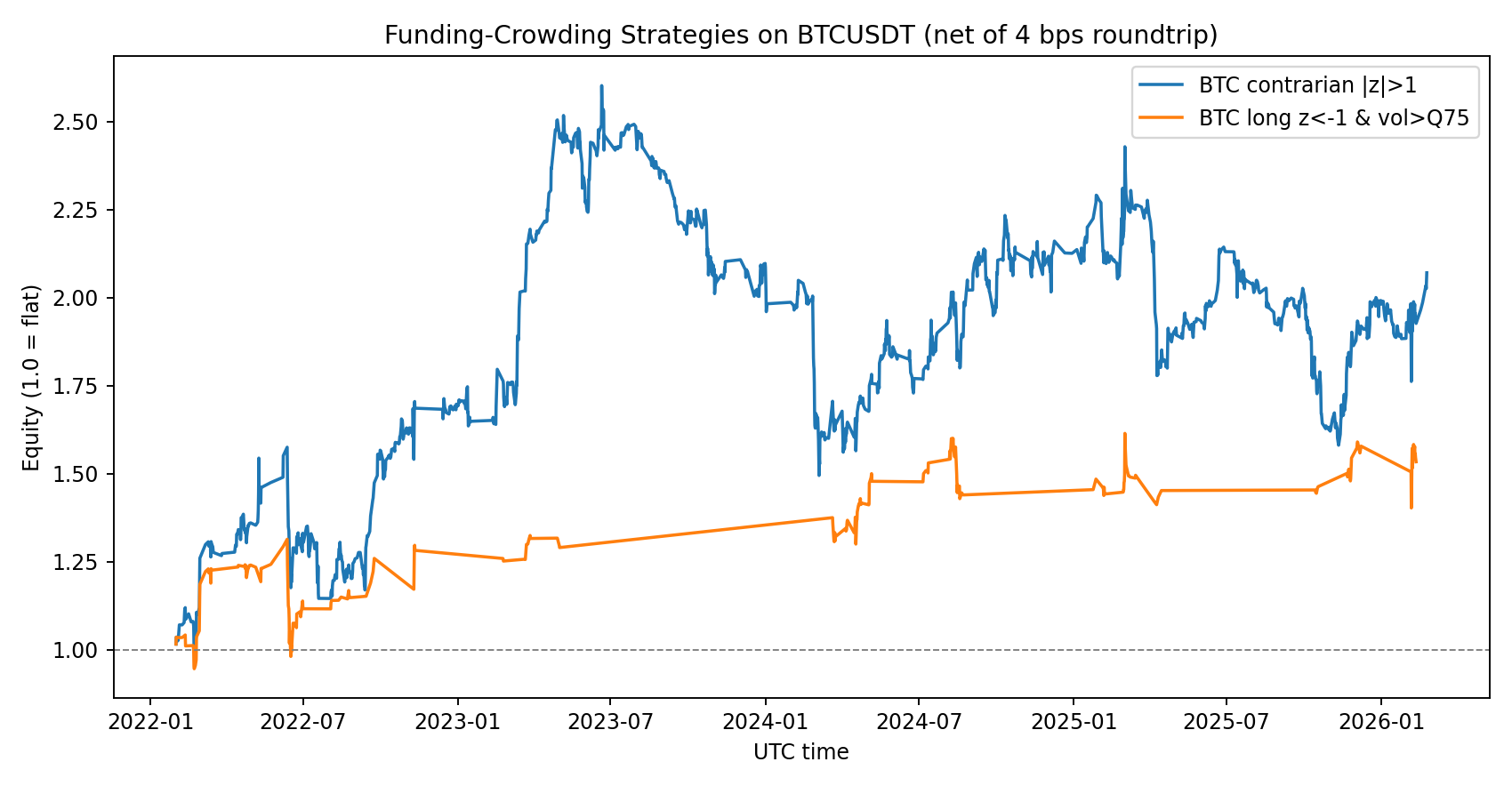
- BTCUSDT: 1,438 trades, +6.31 bps/trade, Sharpe 1.32, terminal equity 2.07x
- ETHUSDT: 1,390 trades, -2.54 bps/trade, Sharpe -0.39, terminal equity 0.51x
So this is not a generic “all perps” edge. It is BTC-specific in this sample.
Problem: regime decay
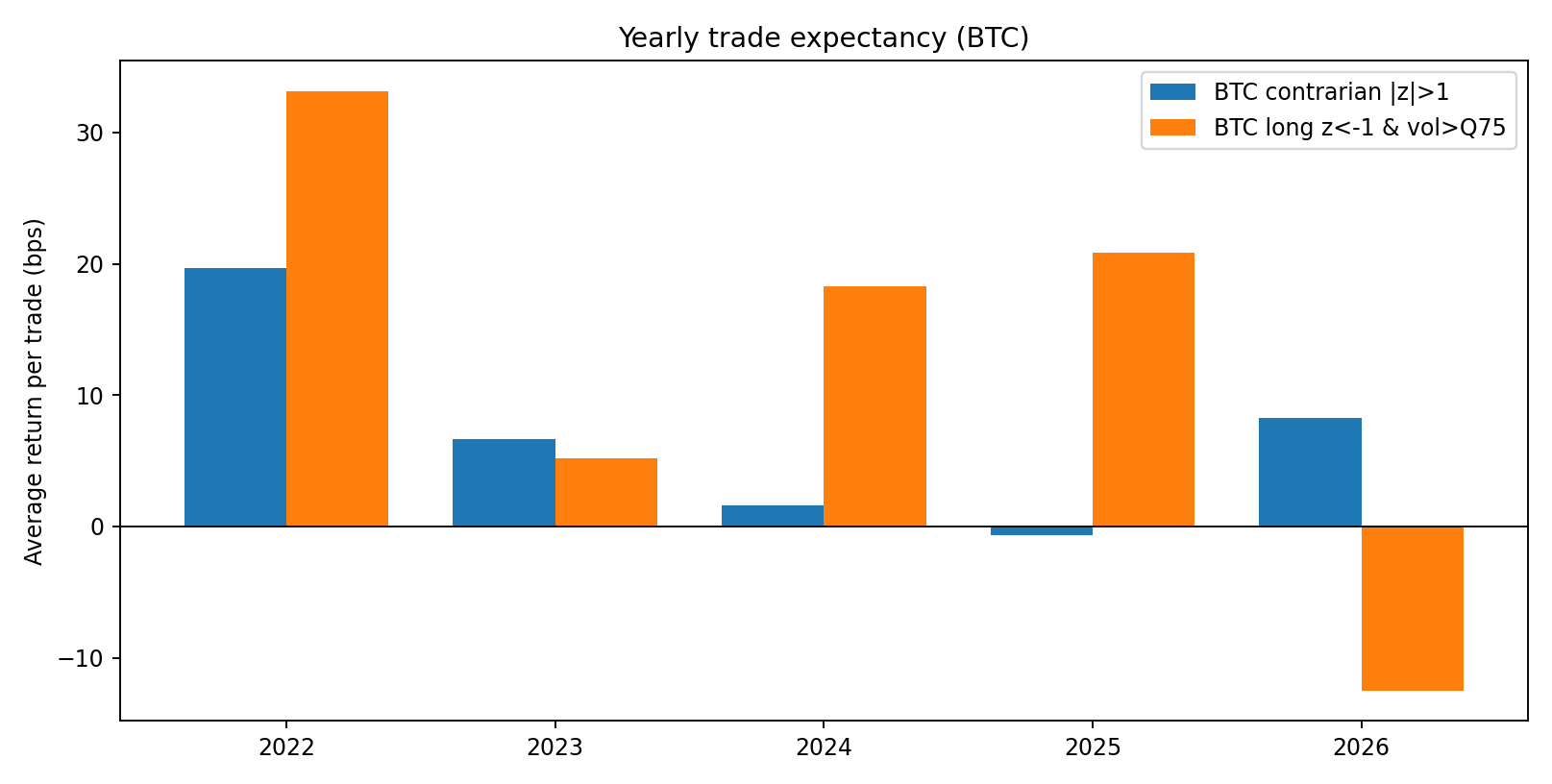
For BTC baseline expectancy by year (bps/trade):
- 2022: +19.65
- 2023: +6.68
- 2024: +1.59
- 2025: -0.65
- 2026 YTD: +8.24
This screams edge compression.
Regime filter: only buy panic funding when vol is high
I then narrowed the trade to the side that historically worked better:
- Only take longs when (z_t < -1) (short crowding extremes)
And add volatility gating:
- 21-interval realized vol (about 1 week)
- trade only when vol is in the top quartile (( > Q_{75}))
Filtered strategy (BTC only)
- 230 trades
- +21.25 bps/trade
- Sharpe 3.06
- terminal equity 1.53x
Most importantly, this filter held up during the compression years better than baseline:
- 2025 filtered expectancy: +20.88 bps/trade (vs baseline -0.65)
Not huge sample size, so I’m treating this as a candidate edge, not production truth.
Interpretation
The edge appears to be less about “funding is extreme” and more about:
funding is extremely negative and market is already in stress, so short positioning gets violently unwound.
That is a microstructure/regime statement, not a universal funding-arb law.
What I learned (hard truth)
- Naive funding contrarian is decaying (especially outside BTC).
- Execution cost is the whole game. At higher fees, this edge dies quickly.
- Regime conditioning beats unconditional signals.
- Cross-asset transfer fails: BTC logic did not carry to ETH in this sample.
Reproducibility
Script and raw outputs are in this post folder:
analyze_funding_regime.pyday16-results.json
Core summary from day16-results.json:
{
  "btc_contrarian_avg_bp": 6.31,
  "eth_contrarian_avg_bp": -2.54,
  "btc_filtered_avg_bp": 21.25
}
Next steps
Before touching real capital, I need to stress this setup with:
- walk-forward threshold tuning (no in-sample cherry-picking),
- latency/slippage-aware execution simulation,
- multi-exchange replication (Bybit/OKX) to reject venue-specific artifacts,
- bootstrap confidence intervals on yearly expectancy.
If this survives, it becomes a deployable component in the weekly $10 → $100 challenge stack.
As always: this is research, not advice. The market does not owe us stationarity.