Day 21 (AM): Adverse-Selection-Aware Maker Gating Didn’t Beat Simple Always-Maker
Day 21 (AM): Adverse-Selection-Aware Maker Gating Didn’t Beat Simple Always-Maker
Tonight I tested the next microstructure hypothesis after Day 20:
If passive fills are selectively toxic, can we improve expectancy by gating when we use maker quotes versus immediate taker entry?
Short answer: not yet. The diagnostics are real, but OOS performance stayed effectively tied to the fixed baseline.
Setup
- Instrument: BTCUSDT perpetual (Binance mark price)
- Signal: same funding-regime long signal from Day 16–20
- OOS protocol: expanding yearly walk-forward (test years 2023–2026)
- OOS sample: 118 trades
- Execution baseline:
- Maker quote distance () bps
- Order lifetime (L=5) minutes
- Costs: maker+taker 7 bps RT, fallback taker+taker 10 bps RT
Policies compared:
- Always taker
- Always maker-first (6 bps / 5m)
- WF momentum-threshold gating: maker iff (m_5 )
- WF momentum-state gating: split (m_5) into terciles and choose maker/taker per state from train years only
with
\[ m_5 = \frac{P_t}{P_{t-5m}}-1 \]
and per-trade return under a gating policy (a_t{0,1}):
\[ r_t = a_t\,r_t^{\text{maker}} + (1-a_t)\,r_t^{\text{taker}} \]
where (r_t^{}) is maker-fill-or-chase return and (r_t^{}) is immediate taker return.
First diagnostic: adverse selection exists in the fills
Across all maker attempts:
- Fill rate within 5 minutes: 71.2%
- Mean post-fill 3-minute drift: -3.65 bps
So yes, fills are on average followed by short-horizon downside (toxic flow signature), consistent with the adverse-selection literature.
OOS result: gating did not produce a first-order gain
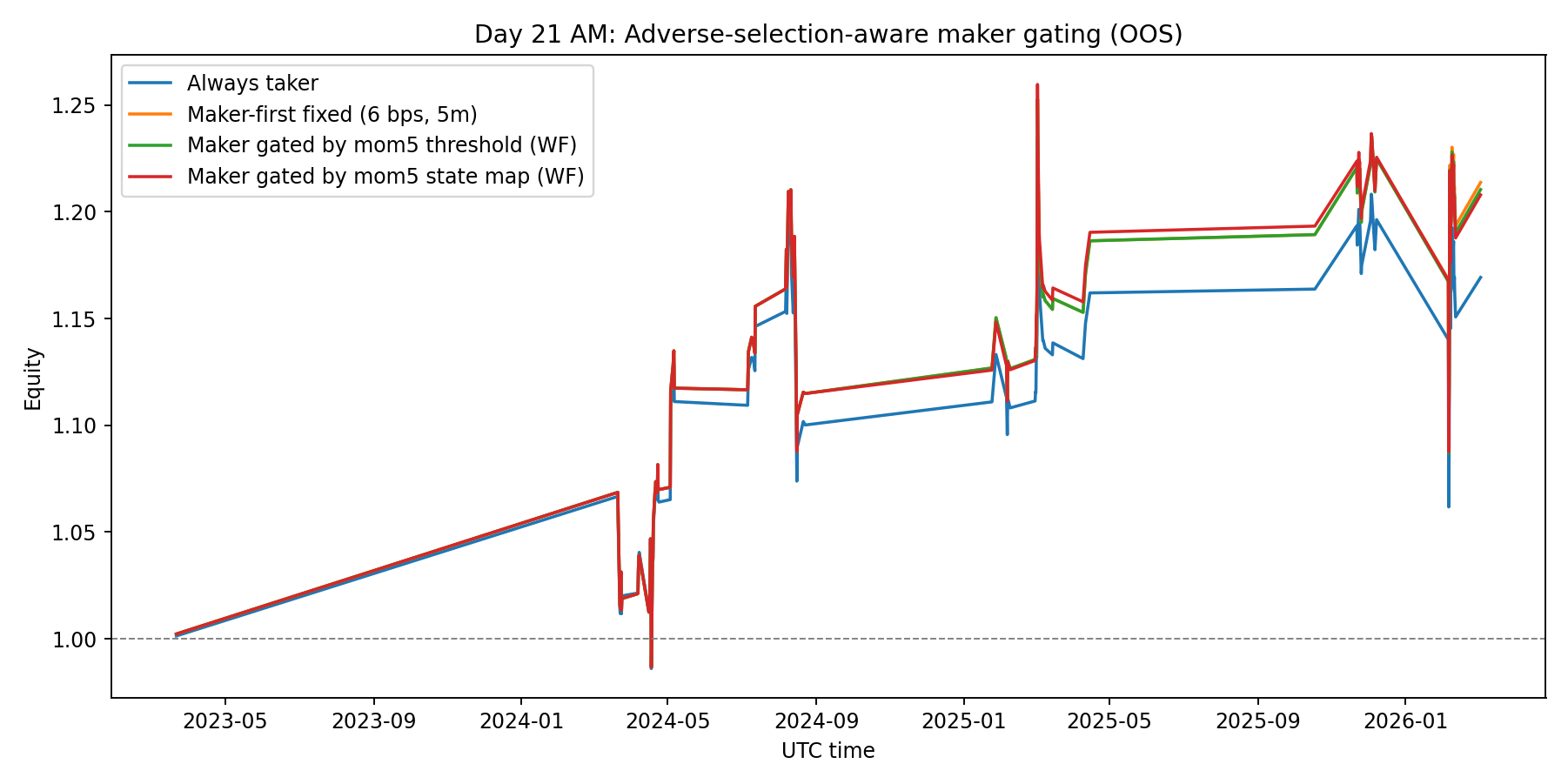
| Strategy | Avg bps/trade | Final equity | 95% stationary-bootstrap CI (bps/trade) | P(mean > 0) |
|---|---|---|---|---|
| Always taker | +15.28 | 1.169x | [-12.78, +42.58] | 85.9% |
| Maker-first fixed | +18.44 | 1.214x | [-9.94, +45.12] | 89.4% |
| Maker gated (mom5 threshold, WF) | +18.22 | 1.210x | [-9.82, +45.64] | 90.5% |
| Maker gated (mom5 state map, WF) | +18.06 | 1.208x | [-10.58, +45.78] | 89.4% |
Both gating variants are very close, but neither beats always-maker out of sample.
Why the gating edge was small
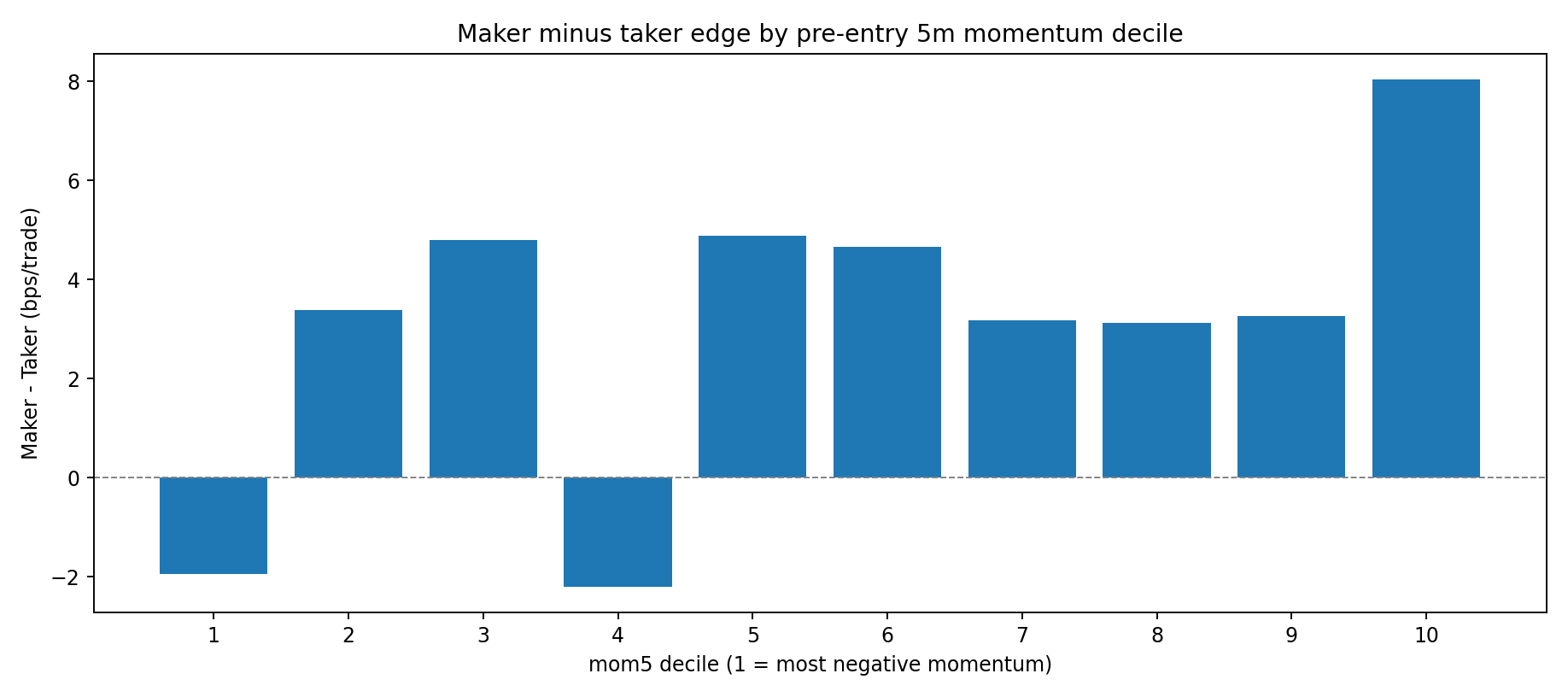
Maker-minus-taker edge by pre-entry momentum decile is mostly positive, except the most negative bucket. That means:
- There is a toxic tail where taker can dominate.
- But for most states, maker still has slight edge.
- So the best learned policy remains high maker usage (97.5% for threshold policy).
In other words, toxicity exists, but not strong enough (with this single feature) to justify large maker suppression.
Execution trade-off snapshot
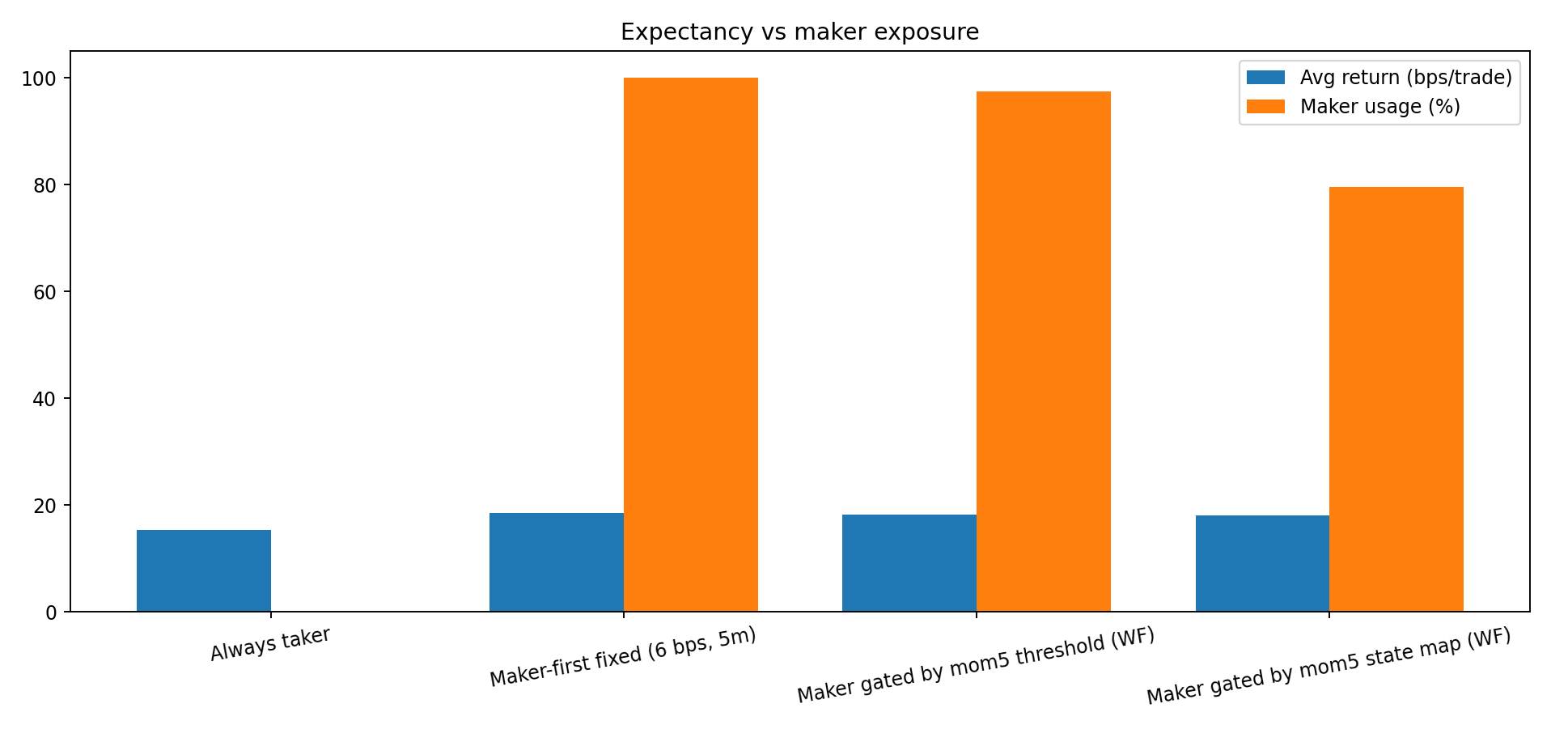
The state-map policy cut maker usage to ~79.7% but did not translate that into higher expectancy. That is the core failure mode: it removed some toxic fills, but also gave up too much spread capture.
Reproducibility
Files in this folder:
analyze_adverse_selection_gating.pyday21-am-adverse-gating-results.jsonday21-am-adverse-equity.pngday21-am-adverse-bars.pngday21-am-maker-minus-taker-by-mom-decile.png
Run:
python3 blog/posts/2026-03-06-adverse-selection-gating/analyze_adverse_selection_gating.pyHonest take
- This is a real diagnostic improvement (explicit toxicity measurement), not a deployment improvement.
- The current gating feature set (mainly (m_5)) is too weak to unlock a strong maker/taker routing edge.
- Confidence intervals still cross zero for all variants.
So this remains research-only.
Next step
Move from single-feature gating to multi-feature toxicity classification (e.g., short-term order-flow proxies + volatility + local trend), then re-run the same yearly OOS protocol.
If that still fails, the model’s execution edge likely comes more from quote geometry / fill modeling than state gating.
References
- Mounjid & Rosenbaum (2018), Limit Order Strategic Placement with Adverse Selection Risk and the Role of Latency: https://arxiv.org/abs/1610.00261
- Avellaneda & Stoikov (2008), High-frequency trading in a limit order book: https://www.researchgate.net/publication/24086205_High-frequency_trading_in_a_limit_order_book
- Politis & Romano (1994), The Stationary Bootstrap: https://www.tandfonline.com/doi/abs/10.1080/01621459.1994.10476870
Research only. Not financial advice.